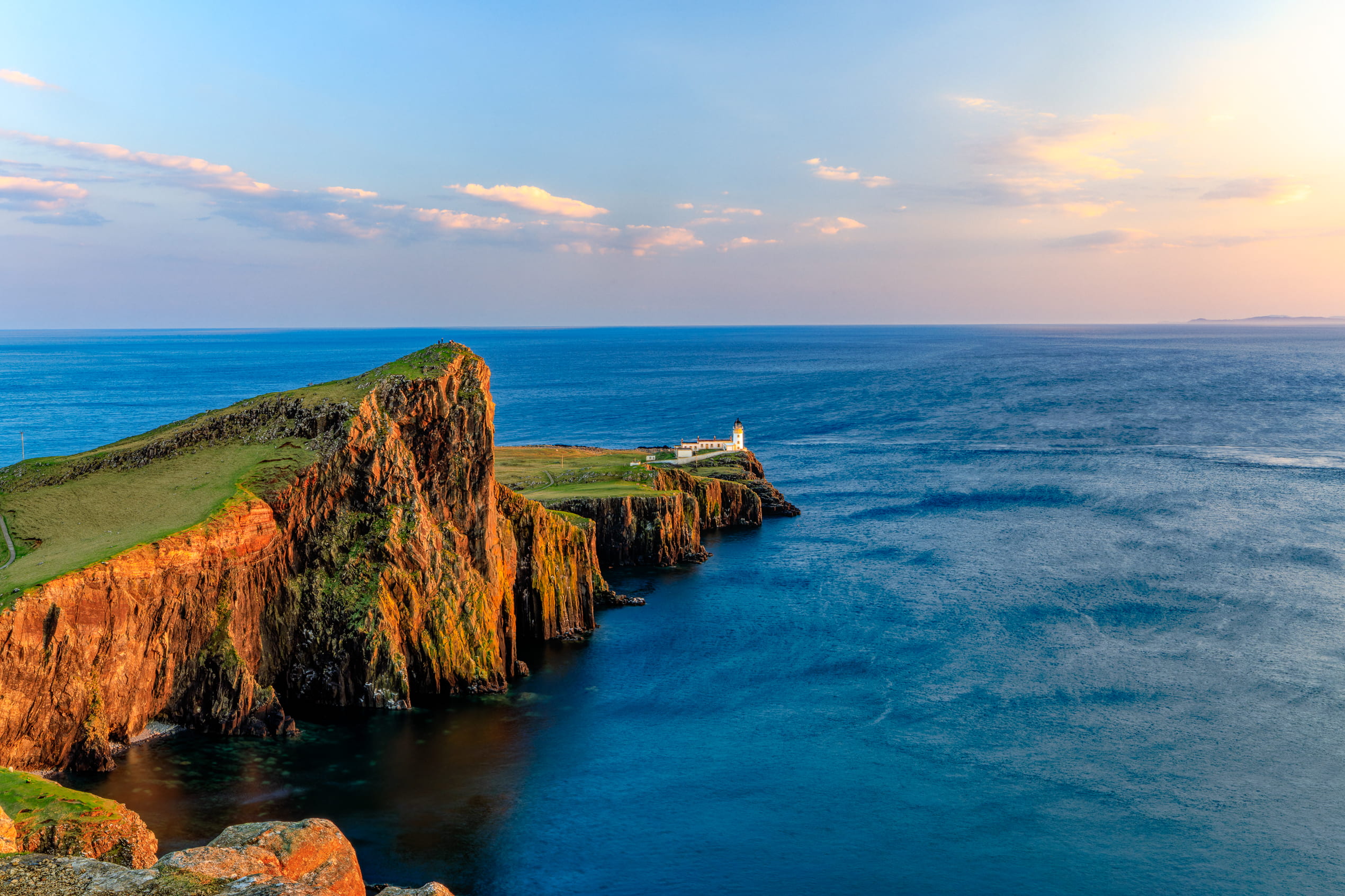
Scotland’s west coast and island chains are among the most biologically and geologically rich landscapes in Europe — and among the least visited, which is a significant part of their value. This guide treats Edinburgh and Glasgow as part of that story, not as places to rush through on the way to a ferry. They are where many visitors land, but they are also where you might spend whole days on food tours, walking tours, markets, pubs, and neighbourhoods that are as much “Scotland” as a puffin cliff or a sea loch. An hour apart by train, the two cities pair easily with a western or island leg — Oban, Mull, and the Isle of Skye (Cuillin, Quiraing, Neist Point) — when you want coast and Hebridean light after the capital or the Clyde.
The Inner Hebrides stretch southwest from the coast of Argyll in an archipelago of sixty-plus islands, most of them uninhabited, all shaped by the same geological forces: volcanic basalt columns, Atlantic erosion, and the particular quality of light that comes from being surrounded by water on three sides. The Isle of Mull is the largest and most accessible, a base for reaching the outlying islands — Staffa, the Treshnish Isles, Colonsay, Oronsay — that contain the finest wildlife and the most dramatic geology.
The Treshnish Isles and Staffa
The Treshnish Isles sit twenty kilometres off the west coast of Mull — a chain of uninhabited volcanic islands that rise in columns of basalt from the Atlantic. Lunga, the largest, is in spring and early summer one of the most extraordinary wildlife spectacles in Britain: a puffin colony of several thousand birds nesting in clifftop burrows, so accustomed to humans that they land within arm’s reach without concern.
Guillemots stack on every available ledge. Razorbills occupy the crevices. Kittiwakes cry from the stacks. Atlantic grey seals haul out on the lower rocks, indifferent. The noise, the smell, the sheer concentration of life in a small space is unlike anything on the mainland.
Staffa, to the northeast, is a different proposition: a volcanic island of hexagonal basalt columns identical in formation to the Giant’s Causeway, formed in the same Paleogene eruption 60 million years ago. Fingal’s Cave cuts into the southern face — a cathedral of basalt with the Atlantic running through it. Felix Mendelssohn visited in 1829 and wrote the Hebrides Overture in response. The cave earns the description.
Edinburgh and Glasgow on this page
Edinburgh belongs here as more than an airport code. The Old and New Towns (UNESCO-listed) reward slow walking — closes, gardens, independent shops — and the city has a deep bench of small-group food tours, whisky tastings, and history-led walks that are proper bookable experiences in their own right. Festival weeks add pressure on rooms and restaurants; outside peak dates, it is easier to linger. When you are ready for open country, Waverley and Haymarket put you on trains toward the Highlands and connections west.
Glasgow is the same kind of destination — not a mere stepping stone to the A82. GLA draws a lot of transatlantic and European traffic; from there the city offers West End dining, Kelvingrove and the museum quarter, live music, and architecture from Charles Rennie Mackintosh to the contemporary riverside. Guided food and street-art style tours are easy to weave into a short city break before you pick up a car or a train to Oban, Fort William, or the Trossachs. The run up Loch Lomond and through Glencoe is world-class driving when you do leave — but Glasgow earns nights on the itinerary, not just a taxi to the rental desk.
Skye and the western islands
The Isle of Skye is connected to the mainland by bridge (no ferry required for the crossing itself). Once on the island, Portree is the main settlement; the Cuillin dominate the southern skyline, while the Trotternish ridge and Quiraing deliver alien, landslip scenery to the north. Skye’s popularity in summer means traffic and parking at famous viewpoints can frustrate; early starts and midweek days help. Mull and Skye pair well on a longer loop (Oban ferries, then Skye via Glen Shiel or Inverness) if you have the time.
The Wider Landscape
The sea eagle — largest raptor in Britain, extinct here for 70 years and reintroduced to Mull in the 1970s — is now seen regularly along the east coast of the island and over Loch na Keal. Otters are common on the sheltered sea lochs. Red deer come down to the shore in winter. The combination of megafauna, seabird colonies and extraordinary geology makes Mull and the surrounding islands one of the strongest wildlife destinations in western Europe.
Getting there
Air: Glasgow Airport (GLA) and Edinburgh Airport (EDI) are the main international hubs. Inverness (INV) is closer to Skye and the Great Glen if your trip is northern-focused. From Ireland, short hops and ferry routes (e.g. Belfast–Cairnryan) also feed into western Scotland by road.
Train: Glasgow–Oban and Glasgow–Mallaig (via Fort William) are two of the great British rail journeys. Edinburgh–Inverness links the capital to the Highland line. Book ahead in summer for sleepers and popular departures.
Ferry: Caledonian MacBrayne services from Oban and Mallaig serve Mull and the Small Isles; Skye is road-accessible via the bridge from Kyle of Lochalsh. Check live timetables — weather can disrupt sailings.
Getting around
A hire car is the flexible default if you want urban days in Glasgow or Edinburgh and then Mull, Skye, or the west coast in one trip. Within the cities themselves, walking, trams (Edinburgh), and the Subway (Glasgow) cover a lot; you may not need a vehicle until you head for the Highlands. On the islands and glens, roads are often single-track with passing places — pull in promptly for oncoming traffic.
Without a car: You can reach Oban and Inverness by train and use local tours and ferries, but reaching multiple islands and viewpoints in one trip is harder; build extra time. The puffin-watching on Treshnish is doable without a car though, more on that to come.
Photographer’s Notes
Lunga in May and early June is among the most productive wildlife photography locations we have visited. The puffins genuinely will just do their own puffiny-things as you photograph. The clifftop grass is thick and green in May with clumps of sea thrift giving pink, which makes a good background.
Staffa is not to be missed. The boat approach from the south shows the full column formation before the landing, it’s definitely worth having a camera ready on the crossing.