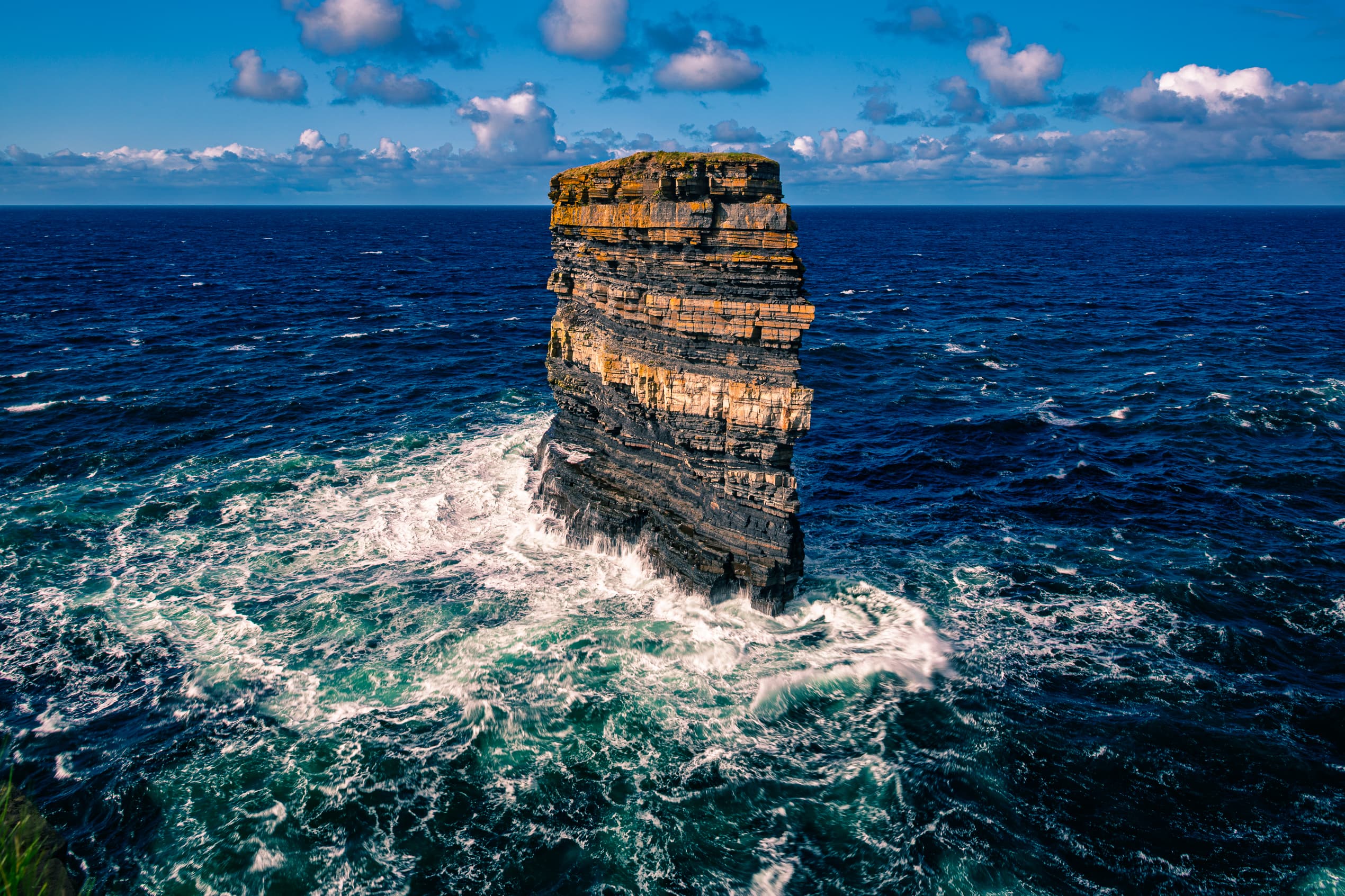
Dún Briste — Downpatrick Head, County Mayo

Location Guide

Ireland

An island shaped by Atlantic weather and deep time

Dún Briste — Downpatrick Head, County Mayo

3 Experiences Curated & verified
1 Echtra Pick Personally assessed
Year-round Season Best availability
wildlife · boat trips · heritage · photography tours · falconry Categories Types of experience
2,500 km Atlantic coastline
2 UNESCO heritage sites

Location guide

The Guide

Ireland is a country that takes a long time to see properly — not because it is large (it is not) but because the light keeps changing what you are looking at.

The island sits at the western edge of Europe, directly exposed to the North Atlantic, and this position shapes everything: the climate, the landscape, the extraordinary quality of the light that shifts from heavy grey to luminous gold within the same hour. Photographers who have worked here talk about the light the way painters talk about Provence. It is not constant, which is exactly the point.

Dublin, Belfast, Cork, Galway, Limerick, Kilkenny, and Waterford are not just airports and motorways on the way to scenery. They are where bookable food tours, literary and history walks, whiskey tastings, market mornings, and neighbourhood dining belong on the same itinerary as a cliff walk or a boat to an island. This guide treats them that way: urban Ireland and rural Ireland share the page, and Echtra Echtra will list experiences in both — from a guided taste of the capital to a day on the Atlantic edge.

The Landscape

The Atlantic coast is the obvious draw — 2,500 kilometres of it, from the sandy beaches of Donegal in the northwest to the limestone pavements of the Burren dissolving into Galway Bay, south through the Cliffs of Moher and the Aran Islands, down the ragged peninsulas of Kerry and the loughs and harbours of Cork. But the interior is equally strange and less visited: the raised bogs of the midlands, the drumlin country of the north, the river meadows of the Shannon basin. These are not dramatic landscapes in the conventional sense. They require a different kind of attention.

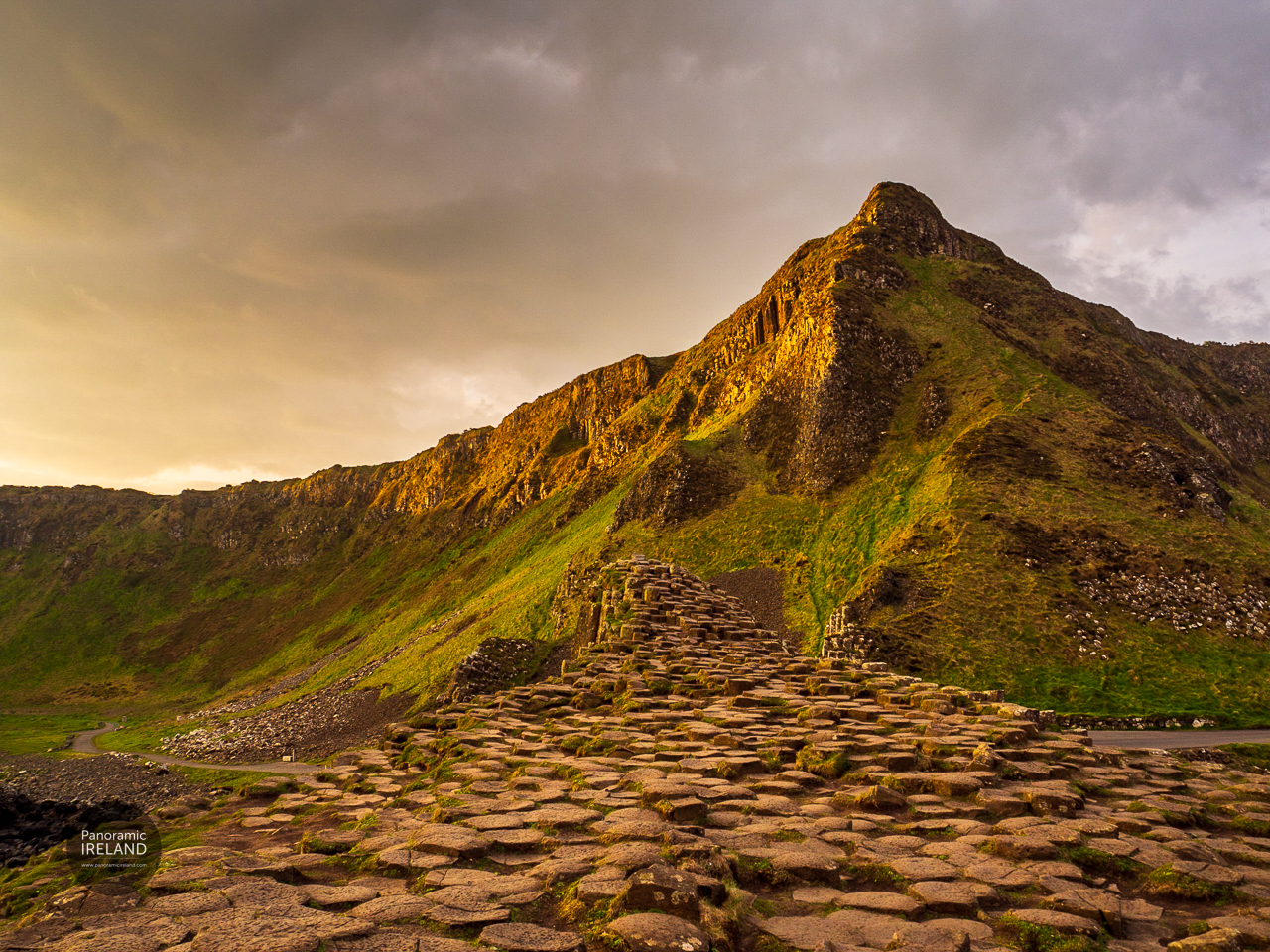
The west is where the geological drama is clearest. The Skellig rocks rise 218 metres from the Atlantic off the Kerry coast, bare and improbable, home to a 6th-century monastery that has survived intact. The Aran Islands are limestone pavements fissured into geometric patterns, bone-white in summer, silver-grey in winter. Connemara is a rugged land of mountain, bog, lake and coastline that refuses to resolve into a single view — the map pin at Clifden is a practical centre for exploring it.

Cities on this page

Dublin rewards slow walking — Georgian squares, the museums around Merrion and Kildare Street, the Liberties and the docklands — and a mature market of small-group food tours and drink-led experiences that are as much “Ireland” as a sheep on a boreen. Belfast pairs Titanic and maritime history with black taxi and mural tours that contextualise the recent past; its dining scene no longer plays second fiddle to anywhere on the island. Cork is walkable, food-obsessed, and close to the coast; Galway compresses festival energy, Irish language culture, and access to Connemara and the Aran Islands into a small city footprint. Kilkenny and Waterford anchor the southeast — medieval streetscapes, craft, and a different pace from the capital. None of these should feel like a box to tick before the “real” trip; they are the real trip when you want them to be.

Archaeology and Deep Time

Ireland has more archaeological monuments per square kilometre than almost anywhere in Europe — and most of them are in open countryside, unfenced, accessible, with no visitor centre explaining what you are looking at. Newgrange, in the Boyne Valley, was built around 3,200 BC, five centuries before the Great Pyramid of Giza. Its passage is aligned to the winter solstice sunrise. There are 40,000 ring forts across the island, most still visible as circular earthworks in fields. Standing stones, portal tombs, court cairns — the evidence of 6,000 years of habitation is everywhere underfoot and largely uninterpreted.

This is one of the things that makes Ireland genuinely unusual as a destination: the past is not in a museum. It is just there, in the landscape, getting rained on.

Photographer’s Notes

The light conditions that make Ireland extraordinary for photography are the same ones that make it difficult to plan around. The most useful advice is to avoid planning for specific conditions and instead to be ready for the weather that appears.

The southwest and west coasts face the Atlantic directly and receive the cleanest light when it clears after rain — typically in the late afternoon and early morning. Kerry and West Cork have the most varied coastal scenery at the shorter focal lengths. The Burren in County Clare photographs well in any light because the limestone holds tone.

Inland, the bogs and loughs and patches of fields bordered by stone walls work best in overcast conditions when the colours — amber, rust, grey-green — are saturated without the contrast of direct sun.

Winter is worth the cold, the light angles are low all day and when sunny it’s remarkably clear and of course, the benefit of fewer people.

Planning

Map & places to stay

Highlights on the map and suggested places to stay — all direct links; Echtra Echtra does not handle hotel booking.

Key spots

Where to stay

Browse by region — each panel expands in place.

Dublin & the East 3
Galway & Connemara 3
Cork & the Southwest 2
Kilkenny & the Southeast 1
  • Lyrath Estate Kilkenny

    Estate hotel minutes from the medieval city — handy for Kilkenny Castle and the southeast coast.

Clare & Shannon 1
Donegal & the Northwest 1
Northern Ireland 1

Bookable Experiences

Experiences in Ireland

Planning Your Visit

When to Go

Spring

Mar – May

March to May brings extraordinary light — low, sideways, constantly shifting. The bog cotton is out on the uplands. Atlantic storms give way without warning to days of complete stillness. Skellig Michael landing tours begin in mid-May.

Summer

Jun – Aug

June and July are the peak months for the Skellig crossing, puffin watching on the Blaskets, and the long Atlantic evenings when the light doesn't go until nearly midnight. The interior is emptier than the coasts — worth remembering.

Autumn

Sep – Nov

September and October are arguably the best months photographically. Lower light angles all day, turning bracken on the hills, the first Atlantic storms coming in from the southwest. Most visitor pressure has gone.

Winter

Dec – Feb

December to February: storm watching on the Wild Atlantic Way is its own kind of experience. The light when it appears is extraordinary — long golden hours at either end of a short day. Many coastal experiences close, but the landscape is at its most raw.